
Introduction
The Latin American gas market is growing. Contractual complexity will grow with it.
The expansion of gas markets does more than create new commercial opportunities; it also tends to generate new sources of conflict. Europe and Asia offer clear examples of how the expansion of gas trade, the liberalization of markets, and the rise of LNG reshaped contractual relationships between buyers and sellers, leading to a significant increase in renegotiations and arbitrations. Latin America appears to be moving toward a similar stage. Expected growth in natural gas consumption, the development of regional infrastructure, and the increasing relevance of LNG are reshaping the structure of the market.This article examines the main trends behind that transformation and the implications they may have for dispute resolution in the energy sector.
From Market Growth to Dispute Risk
Latin America has significant potential for growth in its gas market, and natural gas is likely to play a central role as a “transition fuel” in the years ahead. Rising regional demand and production are expected to drive deeper integration across Latin American energy markets and strengthen the region’s position within the global gas sector.
The experience of other regions, however, shows that the growth of gas markets is often accompanied by greater contractual complexity. As traded volumes increase, new infrastructure is developed, and more private participants enter the market, disputes also emerge over pricing, supply conditions, delivery obligations, and contractual review mechanisms.
Europe and Asia provide clear examples of this evolution. The liberalization of their gas markets, the growing relevance of liquefied natural gas (LNG), and changes in price formation mechanisms led to a significant increase in contractual renegotiations, mediations, and international arbitrations between buyers and sellers.
This article explores some of the trends transforming the Latin American gas market and considers why these developments may translate into greater mediation and arbitration activity in the years ahead.
Growth Potential in the Latin American Gas Market
Although natural gas consumption in Latin America grew only modestly during the 2015–2025 period, several countries — including Mexico, Chile, Peru, and Trinidad and Tobago — recorded meaningful gains. Looking ahead to the next decade, the outlook for the region is considerably more favorable.
According to OLADE projections, natural gas could increase its share of the regional energy mix from 26% in 2025 to 32% in 2035 under accelerated decarbonization scenarios.1 This expected growth reflects the role natural gas is likely to play as a transition fuel, helping reduce emissions while renewable technologies and other lower-carbon alternatives continue to develop.
Natural Gas Will Gain Relevance as a Transition Energy Source in Latin America
Estimated share of natural gas in the regional energy mix under an accelerated decarbonization scenario
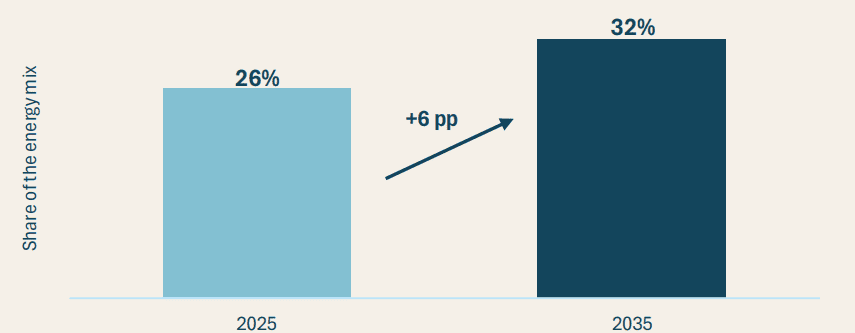
Why Does It Matter? Expected growth in natural gas will drive new investment, greater regional integration, and increasing sophistication in supply contracts.
Source: OLADE, Latin America and the Caribbean Energy Outlook 2025.
In addition to population and GDP growth, the main factors likely to shape natural gas demand include: its ability to displace more carbon-intensive fossil fuels; the pace at which renewables penetrate power generation and the back-up role gas plays in addressing intermittency; the development of alternatives such as biogas, green hydrogen, and synthetic fuels; the deployment of carbon capture and storage technologies; and each country’s ability to make the investments required to build gas infrastructure.
1OLADE, Panorama Energético de América Latina y el Caribe 2025, available at: https://www.olade.org/publicaciones/panorama-energetico-de-america-latina-y-el-caribe-2025/
As in other parts of the world, Latin America is moving through a complex process of reducing greenhouse gas emissions. In that context, natural gas is likely to play a particularly important role as a transition of fuel, enabling a gradual reduction in emissions while other energy alternatives continue to mature.
Greater momentum in natural gas consumption is likely to be accompanied by four defining features:
- Higher regional natural gas production. Taken as a whole, Latin America currently faces a significant natural gas deficit — that is, domestic consumption exceeds domestic production — estimated at approximately 68 billion cubic meters2. Argentina and Brazil appear to be the countries with the greatest short-term capacity to increase production, although others, such as Mexico, Venezuela, and Colombia, also have plans to expand output.
-
Infrastructure development.
Growth will also depend on the development of infrastructure, including both pipeline networks and regasification and liquefaction facilities that can support larger LNG imports and exports.
There are currently ten countries in the region with operating regasification terminals, and several additional terminals are under construction. Argentina and Mexico are making significant investments in new liquefaction facilities — such as Southern Energy in Argentina and Energía Costa Azul in Mexico — which will complement existing capacity in Peru and Trinidad and Tobago. The expansion of gas pipeline networks will strengthen connections with producing fields, distribution systems, and major consumption centers, while also increasing access to U.S. gas. More broadly, it will support deeper regional integration of Latin American gas markets by facilitating, for example, exports from Vaca Muerta to gas-importing countries in the region.
-
Increasing liberalization of gas markets in Latin America.
A third defining feature of the region’s gas market evolution is the gradual liberalization of gas markets across Latin America. This trend is particularly visible in countries such as Chile, where a significant degree of liberalization has existed since the 1980s, and in Argentina, Brazil, and Colombia, which have made important progress in recent years.
Liberalization typically involves the dismantling of state monopolies, a growing number of private participants contracting freely in wholesale and retail markets, and gas prices increasingly determined by supply and demand rather than administrative intervention.Where gas transmission networks remain state-owned — as is often the case given their natural monopoly characteristics — regulation must ensure open and non-discriminatory access for third-party users.Brazil’s 2021 Gas Law and Argentina’s ongoing reform of its 2020 Plan Gas framework are recent examples of liberalization efforts aimed at fostering agreements between private market participants.As the number of market players increases and commercial relationships become more sophisticated, the importance of effective dispute resolution mechanisms grows with them.
-
Price formation in gas supply contracts.
A fourth critical feature is the evolution of pricing mechanisms in gas supply contracts across Latin America.In the United States and Europe, the introduction of competition in gas markets led to the development of gas hubs — physical or virtual trading points where gas sale and purchase contracts are exchanged under standardized contractual structures and with mechanisms designed to manage counterparty risk.These hubs depend on the participation of a large number of buyers and sellers, which generates liquidity and allows wholesale gas prices to form freely in the market.
Wholesale prices formed at these hubs often serve as benchmarks for gas import contracts, both short-term and long-term. Two of the most prominent examples are Henry Hub3 in the United States and TTF4 in the Netherlands.
Henry Hub and TTF: Benchmarks Supported by Liquidity
Henry Hub and TTF concentrate high trading volumes and liquidity, supporting market-based price formation.
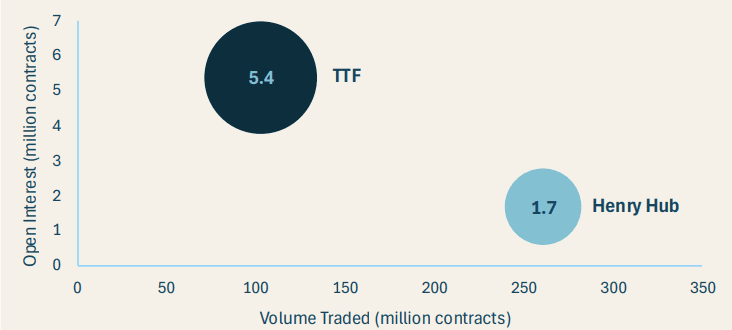
Why Does It Matter? The liquidity of these markets allows their prices to be used as benchmarks in international gas and LNG contracts.
Source: CME Group and Intercontinental Exchange (ICE).
As Latin American countries move forward with gas market liberalization, the increase in market participants, liquidity, and trading activity is likely to create the conditions for the emergence of regional hubs with their own market-based price signals. These prices could then become the relevant contractual reference points for gas sold into the markets where it is ultimately consumed. Given the size of their gas markets, Argentina, Brazil, and Mexico are the countries most likely to develop the region’s leading hubs.
In the absence of developed “hubs” with their own price signals, gas imports (whether by pipeline or as LNG) are fundamentally based on three alternative pricing systems:
- gas prices indexed to crude oil or petroleum product prices;
- prices based on indices from “hubs” in other countries, such as, for example, the benchmark of the exporting country (Henry Hub price, in the case of imports from the U.S.);
- prices regulated by the government or based on the production cost of the exporting country.
Thus, for example, pipeline gas exports from the U.S. to Mexico are currently mainly linked to the Henry Hub price and logistics costs, while the export price of Vaca Muerta gas to Brazil is fundamentally based on the local cost of gas extraction and transportation costs. By contrast, traditional pipeline gas export contracts from Bolivia and LNG contracts from Trinidad and Tobago (until they were renegotiated a few years ago) were based on the price of oil.
The evolution of these pricing mechanisms will likely be one of the factors determining the structure of future supply contracts in the region. International experience shows that disagreements over pricing formulas and contractual review mechanisms are often a recurring source of disputes in more developed gas markets.
22024 figure, measured as the difference between domestic production and consumption, according to the Energy Institute’s Statistical Review of World Energy 2025. Available at: https://www.energyinst.org/statistical-review
3Reference hub for natural gas price formation in the United States, widely used as a benchmark in gas supply contracts and international gas trading transactions.
4Title Transfer Facility (TTF), the leading benchmark market for natural gas price formation in Europe.
LNG in Latin America: Toward a More Complex Market
The International Gas Union (IGU), in its annual report on wholesale gas price formation5, indicates that in 2025, 74.4% of total gas imports in Latin America (excluding Mexico) had pricing formulas linked to gas market references (Gas-on-Gas, GOG6), while 25.6% were indexed to oil prices (Oil Price Escalation, OPE7). In the case of LNG imports, the share of GOG contracts was 100%, as cargoes originated mainly from the U.S. and Trinidad and Tobago, countries whose sales prices to the Americas are linked primarily to the Henry Hub price.
Pricing Mechanisms for Total Gas Imports in Latin America (2025)
Share of gas imports by pricing mechanism
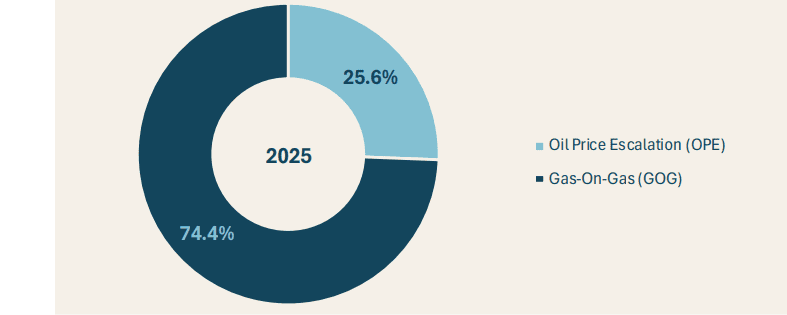
Why Does It Matter? The liberalization of gas markets increases the relevance of pricing clauses and their potential to give rise to disputes.
Source: International Gas Union (IGU), 2025 Wholesale Gas Price Survey.
However, when considering total natural gas consumption (domestic production and imports) in 2025, the share of contracts with sales prices linked to gas markets (GOG) falls to 39%, as many domestic production sales prices are government-regulated, based on production costs (Argentina), oil prices (Brazil), or politically subsidized prices (Venezuela). The main gas-producing countries, Argentina and Brazil, are already implementing greater liberalization in this area.
The progressive liberalization of the gas sector in Latin America will increase the importance of mediation and arbitration cases between buyers and sellers, both in the domestic market and in export activities. The emergence of new private operators, the expected growth in gas volumes, the formation of new “hubs” with reference prices, the renegotiation of pricing formulas to reflect the dynamics of the gas market itself, and greater regional integration are new circumstances that will likely generate disputes and conflicts between the parties, the resolution of which will require experts capable of mediating based on their knowledge of local markets and their experience in more mature markets such as Europe or Asia.
At present, LNG imports in Latin America remain limited. According to a report by the International Group of LNG Importers (GIIGNL), Latin America imported 12.3 MT of LNG in 2025, of which 4.3 MT corresponded to “spot” or short-term contracts. Brazil, Chile, and the Dominican Republic led purchases. Various analysts forecast that LNG contracting in the region will increase in the coming years, with approximately 90 MT of available capacity already in regasification terminals.
LNG offers operational flexibility that pipeline imports do not, although it also presents risks, such as the possibility that some cargoes destined for the region may be diverted to other regions, such as Asia or Europe, in response to price competition that may arise during periods of tight supply. In this regard, long-term contracts provide greater security of supply than “spot” contracting, as they are more protected against diversion risks and are therefore better suited to covering firm gas demand, such as that required by the electricity needs of data processing centers or gas-intensive industries. That same flexibility, however, can become a source of contractual tension when market conditions encourage the diversion of cargoes or alter the economic incentives originally envisaged by the parties.
Long-term LNG contracts are based on a balanced allocation of risks negotiated between the buyer and the seller. They contain multiple clauses which, taken together, determine the degree of flexibility of the contract. The breach of any of these clauses often gives rise to disputes that end in mediation or international arbitration, since they may imply a breakdown of the balance agreed during the contract negotiation.
The experience of Europe and Asia shows that, as their dependence on LNG increased, multiple contractual disputes associated with these agreements also emerged. Some examples of clauses that have given rise to disputes are the following:
- The possibility of renegotiating the gas price, when the agreed price no longer reflects the value of gas in the end market. These clauses were more common in OPE contracts than in GOG contracts, although in certain cases they may also apply to the latter.
- Penalties for failure by the seller to deliver or by the buyer to take the committed gas volumes.
- Negative consequences of cargo diversions to other ports or countries by the seller seeking a higher margin, or by the buyer, when the ports of destination are specified in the contract.
- Failure to comply with the conditions for re-export (in contracts that are not FOB).
- Exceeding the tolerated flexibility margins (whether above or below) for the agreed gas quantities.
- Payment obligations even where the gas is not taken (such as a “take-or-pay” clause).
- The occurrence of any of the circumstances triggering the application of a Force Majeure clause, with temporary or permanent suspension of the contract.
5IGU, 2026 Wholesale Gas Price Survey. Available at: www.igu.org/igu-reports/2026-wholesale-gas-price-survey.
6Pricing mechanism under which the value of gas is determined by reference to competitive gas markets rather than to other fuels such as oil.
7Pricing formula under which the value of gas is indexed to the price of oil or petroleum products.
These are some of the conditions that may be included in the contractual provisions and that may generate conflicts between the parties and lead to mediation or arbitration. Some of them also apply to short-term contracts and to pipeline gas supply. For example, the diversion of cargoes to other countries with higher gas prices or the re-export of LNG may also be a source of conflict in short-term contracts. Exceeding the tolerated gas quantity margins or “take-or-pay” are examples that may also affect long-term pipeline contracts. The variety of scenarios that may give rise to disputes reflects the growing sophistication of gas and LNG supply contracts. As a result, the resolution of these disputes often requires not only legal analysis, but also a detailed understanding of energy markets and of the parties’ economic incentives.
Delays in investments in the infrastructure required for loading and unloading, non-payment, lack of transportation means, armed conflicts such as the war in Ukraine, natural disasters, epidemics, or simply significant changes in energy markets at the national or international level are circumstances that may lead one of the parties to invoke one of these clauses, thereby generating a disagreement between the parties.
How We Approach It at Fortantis
For producers, marketers, distributors, power generators, and investors, the evolution of the Latin American gas market represents a significant opportunity, but also a potential source of contractual risk. International experience shows that many of these disputes do not arise from obvious breaches, but rather from structural changes in markets that alter the economic balance originally envisaged by the parties.
In that context, the ability to technically analyze market conditions, assess economic impacts, and quantify damages becomes increasingly relevant in negotiation, mediation, and arbitration processes.
Fortantis is involved in these matters by providing economic analysis, energy market assessment, and quantification of impacts arising from complex contractual disputes.
Our Team
Fortantis is a boutique firm specialized in damages quantification and valuation in international arbitration. This is the team behind the analysis.
Author

Fernando Maravall
More than 40 years in the energy sector. He served as CEO of CEPSA and developed oil and gas projects in Spain, Latin America, and Arab countries. Expert in energy disputes and arbitrations.
LinkedInFortantis Team

Samuel García-Cuéllar
More than 25 years of experience in valuation and corporate finance. He has supported public and private clients in damages quantification in complex disputes across Mexico, the United States, and Latin America.
LinkedIn
Juan Pablo Olivera Catrip
Holds a degree in Financial Management from ITAM; prior experience at Santander Asset Management and HSBC.
LinkedIn
José Andrés Baquero
Holds a degree in Financial Management from Universidad Anáhuac; prior experience at Andersen (Mexico) and Banco Pichincha (Ecuador).
LinkedInSources and Legal Disclaimer
Sources: OLADE, Panorama Energético de América Latina y el Caribe 2025 (primary source of regional projections); International Gas Union (IGU), Wholesale Gas Price Survey 2025; International Group of LNG Importers (GIIGNL), Annual Report 2025; CME Group and Intercontinental Exchange (ICE), Henry Hub and TTF market statistics.
© 2026 Fortantis. All rights reserved. This document has been prepared for informational and general analytical purposes, based on publicly available information as of the date hereof. It does not constitute legal, financial, or investment advice, nor an expert opinion on any specific matter. Artificial intelligence-assisted tools may have been used to support structuring, editorial review, or preliminary analysis tasks. In no event did such tools replace the professional judgment of the authors, who reviewed, validated, and approved the final content. The figures and scenarios presented are illustrative approximations and should not be interpreted as an independent valuation or as a prediction of the outcome of any arbitration. Fortantis does not guarantee the accuracy, completeness, or currency of the information used. No part of this publication may be reproduced or distributed without Fortantis’ prior authorization.