

When a reservoir extends across several contract areas operated by different companies, petroleum regulations usually require it to be developed as a single unit. Defining each area’s participation requires estimating subsurface volumes under uncertainty, and that figure governs the allocation of costs and production over the entire life of the field. Using the Zama unitization as a reference point, this article examines why the redetermination of participations, the designation of the operator, and decision-making rules account for most of the disputes.
Introduction
The unitized development of hydrocarbon reservoirs that “straddle” several contract areas operated by different companies is undertaken to improve efficiency and productivity compared with developing each area individually. Negotiating and operating a unitization is a long and complex process, with a high risk of disputes and conflicts among the companies. In this article, we discuss why these disputes arise and how they can be addressed.
Oil field unitization
A problem that frequently arises in the exploration and production of hydrocarbon fields, and that gives rise to many disputes, is when a discovered reservoir extends across several adjacent contract areas operated by different contractor companies. In this case, because the subsurface reserves span several contract areas, they affect several exploration and production contracts. If each company were allowed to carry out production activities within its own area, on its own, without regard to the consequences for the adjacent area, significant inefficiencies could arise from duplicated operating expenses, excessive investment, or the depletion of one party’s reserves due to overproduction by the other.
In many countries, Mexico among them, petroleum legislation requires that, once the delineation of a reservoir confirms that it extends across several areas, a procedure be applied to form a single production unit and operate the reservoir jointly (a procedure known as unitization)1. The aim is to optimize the management of the reservoir’s development, minimizing costs and leveraging economies of scale and the experience of the companies involved.
A recent and highly relevant example in Mexico is the Zama reservoir, in the shallow waters of the Gulf of Mexico, discovered in 2017 with estimated recoverable resources of around 750 million barrels of oil equivalent. The reservoir straddles the Uchukil assignment, where PEMEX was the operator, and Block 7, held by a consortium of private contractor companies, where Talos was the operator. The National Hydrocarbons Commission (CNH) confirmed the reservoir’s hydraulic connectivity in 2020 and, based on that determination, the Ministry of Energy (SENER) ordered the unitization. On March 22, 2022, SENER issued the Unitization Resolution, which set the final terms and conditions of the agreement. The CNH’s approval of the Development Plan for the Extraction of the Unitized Area came later, on June 1, 20232.
If the reservoir spanning several contract areas is constituted as a unit, the companies involved give up the individual development of their respective areas and negotiate a single operating agreement, which generally must be approved by the government. This joint operating contract is called a Unitization and Unit Operating Agreement (UUOA)3.
The main issues covered by a UUOA can be divided into two broad groups:
- Issues relating to the creation of the unit and its decision-making bodies, each company’s participation in the unit, and the criteria for allocating total costs (OPEX and CAPEX) and production.
- The designation of the unit operator and the rules that define the framework for future operations.
Negotiating the issues in each of these two groups is usually slow and complex and involves several matters that can lead to significant disputes and conflicts between the parties. If these disputes are not settled amicably, they are resolved through private arbitration, an independent expert, or the country’s petroleum authority (a role sometimes mandated by law), depending on the nature of the dispute.
1In Mexico, the obligation to unitize assignments or contracts that share a reservoir is set out in Article 63 of the 2014 Regulations of the Hydrocarbons Law.
2National Hydrocarbons Commission, Press Release 04/2023, June 1, 2023.
3The Association of International Energy Negotiators (AIEN) publishes a standardized model UUOA that is used as an international reference: “Unitization and Unit Operating Agreement,” 2020 edition, https://www.aien.org/model-contracts/.
When the common reservoir is cross-border, straddling two neighboring countries, the governments usually negotiate a joint development agreement based on the existing territorial boundaries. The UUOA is thus subsumed into a broader intergovernmental agreement. There are many examples of cross-border unitizations, such as Great Britain–Norway, Australia–Indonesia, Senegal–Mauritania, and Cameroon–Equatorial Guinea. This article does not address the unitization of cross-border fields.
Main disputes in the creation of the unit and the allocation of costs and revenues.
Creating the unit first requires that all technical information (seismic data, well drilling, production, etc.) gathered since the companies began operating their individual areas be made available to all parties in a common database, so that the reservoir can be evaluated. Second, the common reservoir must be confirmed and delineated (geographically and in depth); it may cover a smaller surface than the sum of the individual areas (if the petroleum-bearing formation does not extend across all of them), in which case part of those areas is left outside the unitization. Third, the participation percentage of each area in the unit (tract participation) must be determined; it is measured as the percentage of the reservoir’s total hydrocarbons stored beneath each contract area.
In reservoirs that are not yet producing, and where technical knowledge is therefore limited, the volume of hydrocarbons in each contract area is calculated under uncertainty, specifically by using probabilistic parameters whose interpretation is contested4. Because the relative participations calculated are the percentages that will later be applied to allocate costs and production among the areas5, it is to be expected that disputes are intense.
When the unit is first created, the companies must agree on the criterion for measuring the volume of hydrocarbons in the subsurface, and several types of measurement exist. For crude oil, for example, the main criteria are based on the estimated volume of oil initially in place, known as original oil in place (OOIP), or, for reservoirs that are already developed, on criteria closer to recoverable reserves.
OOIP is the most widely used criterion for oil fields with early-stage discoveries. It measures the volume of oil initially stored in the rock, whether or not that oil is producible6. It is, for example, the measure used for the Zama field in Mexico, where, after several years of technical discussions, Pemex’s participation was agreed at 50.4%, with the remainder corresponding to the private companies. It is also the criterion used in many shared reservoirs in countries such as the United States, Algeria, Ghana, Senegal, and Indonesia, and in areas such as the North Sea in Europe. By contrast, in cases such as the Tupi pre-salt field in Brazil, participations are calculated using a criterion based on actual production and dynamic reservoir data.
Contracts commonly include a clause providing for the subsequent review of the relative participations initially agreed, because initial calculations are highly approximate and, as time passes and actual knowledge of the reservoir improves, the re-estimated participations may differ considerably from the first estimates. This is known as tract participation redetermination, which the companies carry out because their information about the reservoir increases over time as it is developed and produced.
Redetermination is also a source of conflict because of its economic implications. Not all unitization agreements contain this participation review clause, although it is common practice. It is generally omitted in small unitized fields or in mature fields where knowledge of the reserves in each area is already very precise. One example is the unitization agreement for Peik, a small field of approximately 20 million barrels straddling the United Kingdom and Norway in the North Sea, which omits the clause precisely to avoid the cost and complexity of the process. An example in the opposite direction is the Zama agreement, which contains the redetermination principle, a process the parties will have to carry out in the future.
Renegotiation can be a very long and complex process; in some cases, such as the giant Prudhoe Bay field in Alaska or the Ourhoud field in Algeria’s Berkine Basin, redetermination discussions lasted more than three years. Shifting reserve percentages, sometimes with retroactive economic effect back to the day the first barrel was produced, can have significant implications for the return on investment, which makes the matter highly sensitive for the companies.
The criteria most commonly used in UUOAs to determine when the redetermination process may be triggered are the field reaching certain cumulative production milestones, the completion of contractually committed exploration work, or simply the passage of a set period of time. A UUOA may provide for several redeterminations over the producing life of the field.
The main sources of disagreement among the companies participating in a redetermination are usually differences in the interpretation of the reservoir’s geological and technical data, the validity of the quantitative models used in the estimates, and the method for making participation adjustments once the initial allocation has been corrected. Companies frequently end up turning to an independent expert or private arbitration to settle their differences. When an expert issues an opinion after analyzing the matter in depth, the UUOA usually provides that the decision cannot be challenged by the parties, except in cases of calculation error or if fraudulent conduct is detected.
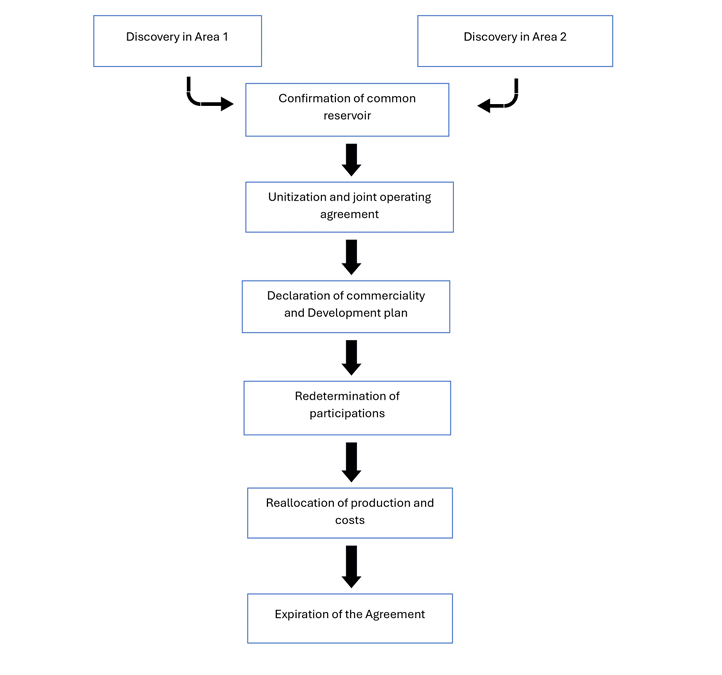
The chart below shows the sequence of the unitization process from its start (confirmation of the common reservoir) to the termination of the agreement, including a redetermination during the process that may readjust the participations agreed in the UUOA and lead to a reallocation of costs and production.
Chart 1: The oil field unitization process
4These parameters relate to the geological and petrophysical characteristics of the rock in which the hydrocarbons are stored (such as porosity, gross rock volume, and degree of saturation), as well as the expected degree of hydrocarbon recovery, all of which are subject to uncertainty.
5Total costs and revenues are allocated among contract areas according to each area’s relative participation, which is the proportion of the reservoir’s total hydrocarbons located in that area. Within each area, if there are several contractor companies, the costs and revenues corresponding to each one will depend on that area’s specific contract. Contractor companies in different areas may have different contractual terms, as well as different fees and royalties. In the Zama example, the Uchukil block was a Pemex assignment, while Block 7 was a contract awarded to a private consortium in Mexico’s Round 1.1, with different contractual characteristics.
6Sometimes reported at surface atmospheric conditions: STOOIP (stock tank OOIP). The calculation is based on static geological and petrophysical measurements.
Potential disputes in the operation of the unit.
The UUOA clauses that make up the second group mentioned above govern the key matters relating to the functioning and operation of the unit. Some of the main ones concern the selection of the operator of the unitized field, its obligations, and the framework within which it must operate; the functioning of the various supervisory and management bodies (operating, technical, and financial committees, etc.); decision-making procedures (on matters such as investments, well locations, budgets, subcontracting, etc.); the rules for conducting operations in the portion of the areas located outside the unit when they interact with it; and the conditions for selling interests to third parties (farm-outs) and for withdrawing from the UUOA. The matters covered by a UUOA are very extensive, and we will refer only to some that are frequently the subject of disputes among the partners.
On the one hand, the selection of the operator is a highly contentious matter. The operator must be technically competent and independent and must guarantee that it will operate the field neutrally with respect to the partners. This is particularly sensitive if a redetermination of the participations of the areas making up the unit is expected in the future. The companies in the area with the largest participation, or those claiming greater experience in this type of development, will seek to be appointed operator. Selecting the operator can involve very lengthy discussions. To continue with the Zama example, after many failed attempts to reach an agreement between Pemex and the foreign companies, SENER initially designated Pemex as operator in 2021, given its larger participation in the unit. In 2025, that decision was changed and Harbour was appointed (with a 32.22% participation versus Pemex’s 50.4%), given its proven experience in reservoirs similar to Zama.
There are numerous cases of unitized fields that change operator after a redetermination process, as the relative participations of the unit’s contract areas shift. Several fields in regions such as Alaska, the North Sea, the Gulf of Mexico, West Africa, and Asia-Pacific have undergone such a change. When one of the partners invokes the greater weight of its participation following a redetermination as grounds for changing the operator, this is often a cause of significant dispute among the companies.
On the other hand, many other matters relating to the joint operation of a unit carry potential for conflict and may arise over the life of the field7. To cite a few examples: a) the deadlock that can arise when, as is often the case, unanimity is required to decide major matters such as investments or budgets; b) the sale of interests to a third party when partner companies claim a possible right of first refusal; c) payment defaults by partners or the wish of one of them to withdraw from the unit; and d) the effects of a force majeure event that interrupts operations. These are disputes that may ultimately require recourse to a dispute resolution mechanism provided for in the contracts.
7Where the conflict is between companies within a contract area, the dispute resolution clause in the specific contract between that area’s partners applies. Where the conflict is between areas, at the unit level, the dispute resolution clause in the UUOA applies.
How Fortantis can help.
As described above, the unitized development of an oil reservoir spanning several contract areas is a complex process that generally involves disputes and conflicts among the contractor companies operating the different areas. The unitization and joint operating agreement approved by the unit partners to ensure the efficient development of the reservoir does not cover every possible contingency and frequently leads the partners to contradictory interpretations of its clauses. As a boutique firm focused on damages quantification and economic expert services for dispute resolution, Fortantis can assist in several capacities, such as:
- Where the dispute is to be resolved through private arbitration, by acting as economic and financial advisor and industry expert to the parties.
- Where the companies have agreed to resolve the dispute through the determination of a technical E&P expert, by assisting in the search for experts and in overseeing and monitoring their work.
- Where the dispute is to be resolved through an administrative decision, by providing economic and technical advice to any of the unit partners in their submissions to the regulatory authority.
Our Team
Fortantis is a boutique firm specializing in damages quantification and valuation in international arbitration. This is the team behind the analysis.
Author

Fernando Maravall
More than 40 years in the energy sector. He served as General Manager of CEPSA and developed oil and gas projects in Spain, Latin America, and Arab countries. Expert in energy disputes and arbitration.
LinkedInFortantis Team

Samuel García-Cuéllar
Samuel has more than 25 years of international experience in finance, with a focus on valuation and corporate finance. He has advised government and private-sector clients on the quantification of damages in complex disputes across Mexico, the United States, and Latin America.
LinkedIn
Alfonso Zendejas
Holds a bachelor's degree in business administration from ITAM, with professional experience at Xepelin and TC Partners in Mexico.
LinkedIn
Juan Pablo Olivera
Holds a bachelor's degree in financial management from ITAM, with professional experience at Santander and HSBC in Mexico.
LinkedIn
José Andrés Baquero
Holds a bachelor's degree in financial management from Universidad Anáhuac, with professional experience at Banco Pichincha (Ecuador) and Andersen Consulting (Mexico).
LinkedInSOURCES AND LEGAL DISCLAIMER
Sources: Regulations of the Hydrocarbons Law (Mexico), Article 63, and SENER’s Guide for the Unitization of Fields or Reservoirs; resolutions and announcements by SENER and the National Hydrocarbons Commission (CNH) regarding the Zama reservoir (2020–2025); public announcements by Talos Energy and Harbour Energy; the AIEN model Unitization and Unit Operating Agreement, 2020 edition; and other public information cited in the article.
© 2026 Fortantis. All rights reserved. This document has been prepared for informational and general analytical purposes based on publicly available information as of the date hereof. It does not constitute legal, financial, or investment advice, nor an expert opinion. Artificial intelligence-assisted tools may have been used to support document structuring, editorial review, or preliminary analysis. In no case did such tools replace the professional judgment of the authors, who reviewed, validated, and approved the final content. The figures and scenarios presented are illustrative approximations and should not be construed as an independent valuation or as a prediction of the outcome of any particular dispute. Fortantis makes no representation or warranty regarding the accuracy, completeness, or currency of the information used. No part of this publication may be reproduced or distributed without the prior authorization of Fortantis.