

Introduction
The Oro Negro case is far more than a dispute between investors and a State. It is a reminder that, in international arbitration, damages can range from virtually zero to hundreds of millions of dollars, depending on how a handful of critical variables are resolved. This wide range does not reflect imprecision, but rather the inherent complexity of quantifying losses in cyclical industries such as offshore oil and gas.
In April 2026, the Ontario Superior Court of Justice reopened the Alicia Grace and others v. Mexico case, setting aside the award that had favored Mexico two years earlier. In doing so, it brought back to the forefront a debate that goes beyond legal technicalities: how much of the future can be considered “reasonably certain” in such a volatile market?
The answer turns on four key levers: shareholder standing, valuation date, the scope of the causal link, and the applicable interest rate. Together, these variables can move the outcome from zero to amounts approaching one billion dollars. In this article, we examine how these legal and financial determinations build upon the same factual record, and why understanding them is essential for any professional involved in investment arbitration.
Beyond Oro Negro, what is ultimately at stake is the credibility of damages quantification models: separating what is attributable to the challenged measure from what is attributable to the market cycle; clearly identifying what is data and what is assumption; and transparently showing how the outcome changes when each variable moves. That is the difference between a number that persuades and one that falls apart under cross-examination.
Context
Integradora de Servicios Petroleros Oro Negro was founded in the 2010s. In a short period, it became one of Mexico’s leading private providers of offshore drilling services. Its business model relied on raising equity and debt to acquire specialized drilling rigs and lease them to Pemex. As a result, Oro Negro was not merely an operating company; it was an asset-intensive investment platform, dependent on contracts with Pemex and external financing.
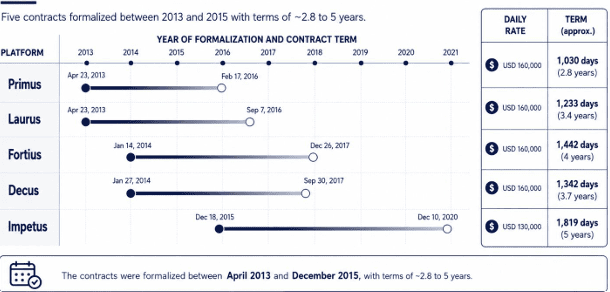
The company raised approximately USD 900 million in debt through international bonds1 to finance the acquisition of self-elevating drilling platforms, known as jack-up rigs. By the end of 2015, it had secured leases for five of those rigs with Pemex, the Mexican state-owned oil company: Primus, Laurus, Fortius, Decus, and Impetus.
The contracts were formalized between April 2013 and December 2015, with terms of approximately 2.8 to 5 years.
Source: Prepared in-house based on publicly available information.
Jack-up rigs are mobile units designed to operate primarily in shallow waters, using extendable legs that rest on the seabed and raise the main structure above sea level. This mechanism allows drilling operations to be carried out with greater stability than other floating platforms in certain environments, in this case, the Gulf of Mexico.
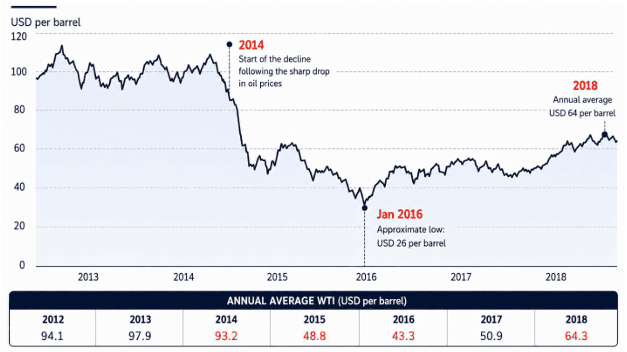
The main indicator of activity in the jack-up rig market is the daily rental rate at which rigs are leased, known as the dayrate. When oil prices rise, companies become more inclined to invest in exploration and drilling, increasing demand for rigs and, in turn, driving up dayrates. When oil prices fall, rig utilization declines, as do dayrates. In 2014, following a significant increase in U.S. oil production through fracking and OPEC’s refusal to cut production, oil prices collapsed: West Texas Intermediate (WTI) fell from levels close to USD 100 per barrel in 2013 to lows near USD 26 per barrel in 2016.2
(WTI) Oil Price
Source: U.S. Energy Information Administration (EIA) – Cushing, OK WTI Spot Price FOB
Against this backdrop, offshore contracts came under pressure globally, as oil companies reduced investment, suspended projects, and renegotiated terms to preserve liquidity. In 2015, Oro Negro accepted temporary reductions in the dayrates of certain rigs, from levels close to USD 160,000 per day to approximately USD 130,000 per day3. In exchange, Pemex granted one-year contract extensions for certain rigs. In 2017, pressure increased once again when Pemex proposed additional amendments, including further rate reductions and temporary suspensions for rigs such as Primus and Laurus.4
1Alicia Grace and others v. United Mexican States, Award, August 19, 2024; Mexico’s Counter-Memorial, sections concerning Oro Negro Drilling’s bond issuance and the acquisition of the rigs.
2U.S. Energy Information Administration, “Cushing, OK WTI Spot Price FOB”; World Bank, “What triggered the oil price plunge of 2014–2016?”, 2018; Behar, A. & Ritz, R., “An Analysis of OPEC’s Strategic Actions, US Shale Growth and the 2014 Oil Price Crash”, IMF Working Paper, 2016.
3Alicia Grace and others v. United Mexican States, Notice of Arbitration, June 19, 2018; Bloomberg, “Pemex Cuts Rig Rates for Oro Negro, Seadrill as Finances Pinched”, September 1, 2015.
4Oro Negro, “Oro Negro Announces Amendments Requested by Pemex to its Jack-up Drilling Contracts”, investor/bondholder communication, 2017.
Commercial Insolvency, Loss of the Rigs, and Arbitration
The Oro Negro conflict did not begin solely as a contractual dispute with Pemex, but as a financial crisis that quickly escalated into commercial insolvency proceedings, litigation in Mexico, and international arbitration.
As alleged by Oro Negro, Pemex had delayed significant dayrate payments, resulting in approximately USD 113 million in overdue lease payments by September 2017. Against this backdrop, that same year Oro Negro sought to be declared insolvent in Mexico, with the aim of protecting the company, its creditors, employees, and shareholders from the potential termination of its contracts and the deterioration of its financial position.
The insolvency proceedings became a critical turning point because the Pemex contracts were Oro Negro’s main economic engine. Without a diversified client portfolio, the company’s financial viability depended largely on the five jack-up rigs continuing to operate under contracts with Pemex. In October 2017, the Mexican state-owned company terminated the contracts related to Oro Negro’s rigs.
The dispute reached the international stage when a group of U.S. investors — the “Claimants” — initiated arbitration against Mexico — the “Respondent” — under Chapter XI of NAFTA5. In their October 2019 Statement of Claim, the Claimants alleged that Mexico had breached its international obligations, including fair and equitable treatment, full protection and security, and expropriation.
The economic core of the arbitration was the Claimants’ allegation that the actions of Pemex and the Mexican State were unlawful and destroyed the value of their investment in Oro Negro. They further argued that Pemex acted in coordination with the ad hoc group of bondholders to terminate the contracts, cut off Oro Negro’s cash flows, and facilitate the creditors’ takeover of the rigs. Under this narrative, the loss of the jack-up rigs was a direct consequence of the contract terminations, Pemex’s failure to pay, and the pressure exerted within the insolvency proceedings.
In its response, Mexico argued that Oro Negro did not lose the rigs as a result of conduct attributable to the State, but rather because of its own financial decisions and defaults arising from its debt structure. From this perspective, the insolvency filing triggered events of default under the bond agreement, allowing the bondholders to enforce security interests over the entities that owned the rigs. Mexico maintained that the loss of the jack-up rigs was explained by Oro Negro’s high leverage, the collateral granted to the bondholders, and the absence of an agreement with its creditors — not by expropriation or unlawful conduct by Pemex.
5NAFTA was replaced by the USMCA in 2020.
Quantification of Damages
It is important to note that the original arbitral tribunal never ruled on the damages quantification presented by the parties, as it unanimously held that it lacked jurisdiction and ordered the Claimants to pay USD 400,000 in costs.6
Even so, with the case now reopened and the possibility that a new arbitral tribunal may review it, we can use the damages quantification7 presented by both parties throughout the arbitral proceedings as a basis to analyze potential scenarios in this new phase.
Oro Negro retained Pablo Spiller and Carla Chavich of Compass Lexecon as damages experts, while Mexico relied on the damages analysis of Dr. José Alberro of Cornerstone Research.
Valuation Scenarios: The Question Behind the Numbers
At first glance, the parties’ valuations appear irreconcilable: the amount claimed by the Claimants is approximately USD 270 million, while the Respondent maintains that damages could be close to zero. However, the source of that divergence is narrower than the gap between the figures suggests. Both parties rely on the same method — discounted cash flow based on free cash flow to equity (FCFE) — assume the same 30-year useful life for the rigs, and structure damages across two periods. The first runs from the termination of the contracts in October 2017 through the contractual expiration date of each rig — up to 56 months, depending on the rig. The second runs from that expiration date through the end of the assets’ useful life, for up to an additional 227 months — almost nineteen years.
The substantive difference does not lie in the first period. The dayrates and utilization levels under the Pemex contracts were contractually agreed, leaving little room for meaningful speculation. The entire controversy is concentrated in the second period, where dayrates and utilization levels in the international offshore market must be projected over nearly two decades. At its core, the economic question in the case is twofold: how much future activity in the global market can be established as reasonably certain, and at what price can the rigs operate in that market?
6Alicia Grace and others v. United Mexican States, Award, August 19, 2024; Ministry of Economy, “ICSID Tribunal Rules in Favor of Mexico in the Case of Alicia Grace and Other Claimants”, 2024.
7The quantification analysis is based on public documents from the arbitration Alicia Grace and others v. United Mexican States, including the award, the parties’ submissions, and public descriptions of the expert reports. The full damages quantification reports and the underlying financial models are not public; therefore, the figures are presented as approximations derived from the information available.
Compass Lexecon’s Two Counterfactuals
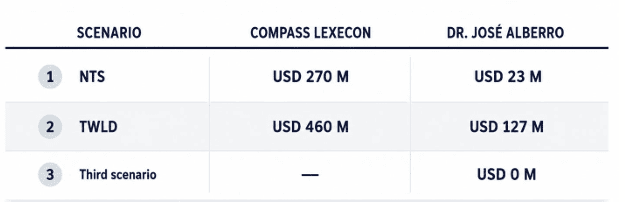
Compass Lexecon, the Claimants’ damages expert, developed two scenarios. The first, referred to as the No Termination Scenario (NTS), assumes that Pemex never terminated the contracts: the rigs operate at the contractual dayrate until each contract’s expiration and are then gradually redeployed in international offshore markets for the remainder of their useful lives, at a market dayrate of approximately USD 120,000 and stabilized utilization of 85%. Under these assumptions, Compass Lexecon estimated Oro Negro’s equity value at approximately USD 625 million. Applying the Claimants’ alleged 43.2% shareholding interest, damages to the Claimants amount to approximately USD 270 million8. This is the amount actually claimed.
The second scenario, referred to as Termination With Liquidated Damages (TWLD), assumes that Pemex did terminate the contracts, but paid the liquidated damages provided for in the event of early termination, after which the rigs would have become available to operate in the global market. Under this approach, damages are approximately USD 460 million. The Claimants do not advance this figure as their primary claim; rather, they present it as a reasonableness check, arguing that even under an analysis that recognizes the termination — provided the contractual clause is honored — damages would exceed their USD 270 million claim.
The Core of the Disagreement
The Respondent, through Dr. Alberro’s analysis, does not reject the method or the definition of the scenarios; rather, it challenges the assumptions applied to the second period. Its central objection is one of principle: projecting nearly nineteen years of operations in a depressed offshore market with an oversupply of rigs departs from the reasonable certainty standard for damages and from case law prohibiting excessive speculation in damages quantification — invoking, among others, the Mobil Investments v. Canada9 precedent. In a market as cyclical as offshore drilling, the Respondent argues, it is not defensible to assume that all five rigs would have been continuously redeployed at attractive rates for two decades, particularly when Oro Negro had never operated outside Mexico.
When Dr. Alberro applies more conservative assumptions regarding dayrates, utilization, cost of capital, and refinancing to Compass Lexecon’s same methodological framework, the results are materially reduced: the NTS falls to approximately USD 23 million and the TWLD to approximately USD 127 million, both based on the 43.2% shareholding interest10. In addition, the Respondent puts forward a third scenario of its own, in which liability is limited exclusively to the cash flows under the Pemex contracts, with no future operations in the global market. Under that assumption, and considering that excess cash would have been used to service the bond debt, damages are reduced to zero.
8Alicia Grace and others v. United Mexican States, Claimants’ Statement of Claim, October 7, 2019, and Mexico’s Statement of Defense.
9Mobil Investments Canada Inc. and Murphy Oil Corporation v. Canada, ICSID Case No. ARB(AF)/07/4, Decision on Liability and on Principles of Quantum, May 22, 2012.
10Alicia Grace and others v. United Mexican States, Mexico’s public submissions and references to the damages quantification report by Dr. José Alberro of Cornerstone Research.
The Resulting Valuation Range
The gap between the valuations, therefore, does not arise from different formulas, but from different assumptions applied to the same model. The following table summarizes the quantum under each scenario and parametrization, applied to the 43.2% shareholding interest claimed by the Claimants:
Expert Damages Valuation
Amounts expressed in millions of dollars (USD M).
Source: Compass Lexecon, Dr. José Alberro.
These figures correspond to the original valuation date — October 2019 — and to the 43.2% shareholding interest. Two additional adjustments could shift them significantly. The first is the shareholding interest ultimately recognized: if the tribunal were to accept the Respondent’s position that only a fraction of the investors meet NAFTA’s requirements, the applicable percentage would be substantially reduced, and all figures in the table would decrease in the same proportion. The second is the passage of time: any amount awarded would need to incorporate interest from the date of harm, which could materially increase the final quantum depending on the applicable rate.
In sum, the quantification of the case turns on a determination of how much future activity in the global market can be considered reasonably certain. If the tribunal accepts the second period on the terms advanced by the Claimants, damages fall in the range of USD 270 million to USD 460 million before interest. If the tribunal rejects that period as speculative, damages fall to a range of zero to USD 127 million. The actual outcome will also depend on the shareholding interest ultimately recognized and the interest regime applied. That is the true breadth of the range in dispute, and the reason why, in controversies like this one, the model’s assumptions matter as much as the facts.
Shareholding Interest
The figures in the table above assume two points that the new tribunal has yet to decide. The first is what percentage of the shareholding interest is effectively protected under the treaty. The Claimants claim 43.2%; the Respondent maintains that only a fraction of the investors meet NAFTA’s requirements, which would reduce the applicable base to approximately 11.08%. Because quantum is calculated by applying that percentage to the equity value, the effect is directly proportional.
The second lever is time. Compass Lexecon’s valuation is fixed as of October 2019. A new award could be issued in 2027, implying nearly eight years of interest between the valuation date and the final decision. Even if the base amount remains unchanged, the applicable interest rate can materially alter the outcome.
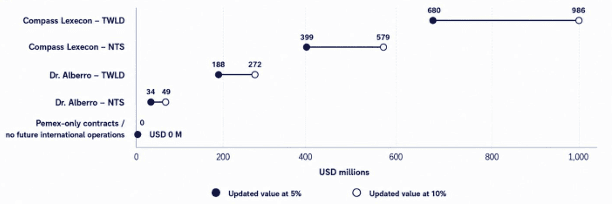
The Parties agree on the use of compound interest, but differ on the applicable rate: the Respondent proposes references close to U.S. dollar-denominated risk-free instruments, while the Claimants argue that only a rate close to the cost of capital of a leveraged offshore investment would fully compensate the harm. The difference between the two positions exceeds USD 200 million on the same base amount.
Potential Quantum Range – Oro Negro v. Mexico
Valuation scenarios based on and updated with compound interest at 8 years. A 5% rate is used as a reference close to U.S. Treasury Bills / risk-free rate in USD; a 10% rate reflects an approximation of the cost of capital assumed by the Claimants. The update considers 8 years of compound annual capitalization.
Source: Prepared in-house based on publicly available information from the arbitration Alicia Grace et al. v. Mexico (Compass Lexecon / Dr. José Alberro), according to public descriptions of the damages quantification. Figures are approximate; full expert reports and financial models are not public.
Combining both levers with the valuation scenarios, the possible outcome of the case ranges from virtually zero — if the tribunal limits liability to the Pemex contracts — to amounts approaching one billion dollars — if it accepts the Claimants’ full scenario, based on a 43.2% shareholding interest, with interest at the cost of capital. This breadth is not a sign of analytical imprecision; it reflects how many independent legal and financial determinations can accumulate on the same factual record.
Why It Matters — and How Fortantis Approaches It
The Oro Negro case illustrates an uncomfortable truth about damages quantification in international arbitration: two competent experts, relying on the same method, the same contracts, and the same company, can arrive at figures that differ by an order of magnitude. The difference lies not in the formulas, but in the assumptions — and in highly complex industries such as offshore drilling, where value depends on projecting dayrates and utilization over a twenty-year horizon, those assumptions are everything.
For that reason, a credible damages analysis is not measured by the final figure it produces, but by the discipline with which it separates what is attributable to the challenged measure from what is attributable to the market cycle; by the transparency with which it identifies what is documented and what is assumed; and by the honesty with which it shows how the outcome changes when each variable moves. That is the difference between a number that persuades a tribunal and one that falls apart under cross-examination.
At Fortantis, we build damages quantification models that do exactly that: they isolate causation, make each assumption explicit, and provide the parties and the tribunal with a clear map of how each legal determination shifts the quantum.
Our Expert Team
Fortantis is a boutique firm specialized in damages quantification and valuation in international arbitration. This is the team behind the analysis.
Author

Samuel García-Cuéllar
With more than 25 years of international finance experience, focused on valuation and corporate finance, he has advised government and private-sector clients on damages quantification in complex disputes across Mexico, the United States, and Latin America.
LinkedInFortantis Team

Fernando Maravall
With over 40 years of experience in the energy sector, he served as CEO of CEPSA and led oil and gas projects across Spain, Latin America, and several Arab countries. He brings deep expertise in energy-related arbitrations.
LinkedIn
Juan Pablo Olivera Catrip
Graduate of ITAM’s Financial Management program, with experience at Santander Asset Management and HSBC.
LinkedIn
José Andrés Baquero
Graduate of Universidad Anáhuac’s Financial Management program, with experience at Andersen in Mexico and Banco Pichincha in Ecuador.
LinkedInSources and Legal Disclaimer
Sources: public arbitration records Alicia Grace and others v. United Mexican States (ICSID Case No. UNCT/18/4) — Statement of Claim and Statement of Defense; U.S. Energy Information Administration.
© 2026 Fortantis. All rights reserved. This document was prepared for informational and general analytical purposes, based on publicly available information as of the date of its preparation. It does not constitute legal, financial, or investment advice, nor an expert opinion on the case. AI-assisted tools may have been used to support structuring, editorial review, or preliminary analysis tasks. Under no circumstances did they replace the professional judgment of the authors, who reviewed, validated, and approved the final content. The figures and scenarios presented are illustrative approximations and should not be interpreted as an independent valuation or as a prediction of the outcome of the arbitration. Fortantis does not guarantee the accuracy, completeness, or timeliness of the information used. No part of this publication may be reproduced or distributed without Fortantis’s prior authorization.